Daily Typing Practice Routine to Increase WPM Faster
For a while, my typing practice looked productive but was mostly random.
I would open a one-minute test, type as fast as possible, restart after a bad sentence, and continue until I found a score worth saving. Some days I gained three or four WPM. The next day, that improvement disappeared.
The problem was not a lack of effort. I had no typing practice routine.
I was measuring my speed repeatedly without giving my fingers time to correct weak keys, poor rhythm, inconsistent finger placement, or accuracy problems.
Once I started following the same short routine each day, the results became easier to understand. I could see whether I was reducing errors, looking at the keyboard less often, or maintaining my speed for longer.
My highest score mattered less than my weekly average.
A useful typing practice routine does not need to take an hour. For most learners, 15 to 20 focused minutes is enough to work on technique, accuracy, speed, and endurance without turning practice into an exhausting test marathon.
This guide provides a complete daily plan, a shorter routine for busy days, and a weekly typing practice schedule you can adjust to your current WPM.
Quick 15-Minute Typing Practice Routine
Use this routine when you want a simple daily structure:
| Time | Activity | Main goal |
|---|---|---|
| Minutes 1–2 | Easy warm-up | Relax your hands and find your rhythm |
| Minutes 3–5 | Accuracy drill | Reduce repeated errors |
| Minutes 6–8 | Weak-key drill | Fix difficult letters and combinations |
| Minutes 9–11 | Natural-text practice | Handle real words, capitals, and punctuation |
| Minutes 12–13 | Controlled speed drill | Type slightly above your comfortable pace |
| Minute 14 | One-minute test | Measure your current performance |
| Minute 15 | Review and record | Select tomorrow’s practice goal |
This daily typing practice plan works because each stage has a different purpose.
You are not expecting one timed test to teach accuracy, technique, speed, punctuation, rhythm, and endurance at the same time.
Why a Typing Practice Routine Works Better Than Random Tests
A typing test tells you what happened. A routine helps you change what happens next.
Suppose you score 43 WPM at 92% accuracy. Another immediate test may produce 44 WPM or 41 WPM.
Neither result explains why you missed certain keys or why your pace dropped halfway through the passage.
A structured typing practice schedule separates the main skills:
- Keyboard familiarity
- Correct finger movement
- Typing accuracy
- Word transitions
- Speed control
- Punctuation
- Typing endurance
- Test consistency
Motor-learning research often distinguishes distributed practice from massed practice. Several studies have found advantages when practice is spread across separate sessions, although the ideal schedule can vary according to the task and study design. This supports using regular, manageable sessions instead of assuming that one long weekly session is always better.
Typing research from Aalto University also found that strong performance was associated with consistent finger-to-key mappings, preparing upcoming keystrokes, and limiting unnecessary whole-hand movement. A structured routine gives you time to train those details instead of only chasing a final WPM number.
Step 1: Start With a Two-Minute Warm-Up
Do not begin your session at maximum speed.
Cold hands, stiff fingers, and an unfamiliar passage can make the first result misleading. A short warm-up helps you settle into a natural typing rhythm before recording anything.
What should you type?
Choose easy, familiar text such as:
- A short paragraph from an article
- Common English sentences
- A personal note
- A simple email draft
- Frequently used words
Type at around 70–80% of your maximum pace.
What should you focus on?
During the warm-up:
- Relax your shoulders.
- Press the keys lightly.
- Keep your eyes on the screen.
- Feel for the F and J key bumps when your hands drift.
- Avoid checking your WPM every few seconds.
- Breathe normally.
The warm-up is not a speed test. It prepares you for the rest of your typing practice routine.
Step 2: Spend Three Minutes on Typing Accuracy Exercises
The next stage of the routine should slow you down.
That sounds strange when your goal is to increase typing speed, but uncontrolled speed normally produces more corrections.
Every correction interrupts your rhythm and adds extra keystrokes.
Choose a paragraph and type at approximately 80–90% of your normal pace. Focus on clean and repeatable movements.
Accuracy-reset method
- Type the paragraph without restarting.
- Notice which mistakes repeat.
- Complete it again at a controlled pace.
- Try to reduce the error count.
- Record the most difficult keys.
These typing accuracy exercises are especially useful when your gross WPM looks good but errors reduce your practical result.
A useful training goal for developing typists is approximately 95–98% accuracy during controlled practice. This is not a universal passing requirement. Schools, employers, and testing platforms may use different standards.
Your typing speed and accuracy should improve together.
A steady 48 WPM with very few errors is usually more useful than a brief 60 WPM result that requires constant Backspace corrections.
Step 3: Complete Three Minutes of Weak-Key Practice
Most learners are not equally slow across the entire keyboard.
You may type smoothly until you reach:
- R and T
- P and O
- M and N
- C and V
- B and N
- Apostrophes
- Numbers
- The right Shift key
A complete test may include each weak key only a few times. Targeted typing drills provide more repetition for difficult movements.
Example: R and T drill
Type these words slowly:
rate
tree
return
report
correct
result
greater
training
Then type:
Regular training produces better results.
The correct report was returned on time.
Example: M and N drill
name
number
minimum
normal
mention
movement
management
Then type:
The manager mentioned the minimum number.
Normal movement becomes easier with practice.
Use the same finger for each key every time.
Aalto’s typing research suggests that clear finger-to-key mapping and reduced whole-hand movement are associated with stronger typing performance.
Weak-key practice is one of the most useful forms of typing practice for beginners, but it also helps experienced typists break a typing speed plateau.
Step 4: Practice Natural Text for Three Minutes
Easy word lists can inflate your WPM without preparing you for real writing.
Natural text contains:
- Capital letters
- Commas and periods
- Apostrophes
- Question marks
- Longer words
- Names
- Dates
- Numbers
- Unfamiliar phrases
Use a paragraph that resembles something you would type at school or work.
For example:
“Can you send the updated report by 3:30 p.m.?” Maria asked. The file includes 12 customer records, three revised totals, and one missing address.
This part of your touch typing practice teaches you to maintain control when the material becomes realistic.
The main eTypingTest tool supports different durations and content types, including common text, quotations, code, numbers, punctuation, capitals, and custom text. It also reports WPM, accuracy, errors, consistency, keyboard activity, and an error heat map.
Use the free typing speed test to rotate between natural paragraphs, punctuation, numbers, and custom practice material.
Step 5: Add a Two-Minute Controlled Speed Drill
Speed practice should challenge your normal pace without destroying your technique.
Use this sequence:
Round 1: 30 seconds at a comfortable pace
Type at the speed where your movements feel controlled.
Round 2: 20 seconds slightly faster
Increase your pace by approximately 5–10%.
Round 3: 30 seconds at a controlled pace
Return to your accurate rhythm.
Rest briefly and repeat the sequence once.
Stop pushing faster when:
- Your accuracy drops sharply.
- You start looking at the keyboard.
- Your shoulders become tense.
- You use different fingers for familiar keys.
- You begin striking the keys harder.
- Your rhythm becomes a series of bursts and pauses.
These short typing drills allow you to experience a quicker pace while protecting your technique.
The goal is not to set a new record during every session. It is to make a slightly faster speed feel comfortable over time.
Step 6: Finish With One Measured Typing Test
Now take one timed test.
Use the one-minute typing test for a quick daily measurement.
The main eTypingTest page explains that a one-minute test is useful for a quick result, while a longer test can provide a more consistent measurement.
Record:
- WPM
- Accuracy
- Errors
- Consistency
- Test mode
- Difficult keys
Do not repeat the test five times until you receive a score you like.
One honest result is more useful for tracking progress than one lucky personal record.
Your daily goal is not always to improve WPM immediately. Some sessions should improve your accuracy, consistency, or control.
Those changes often appear before the next increase in speed.
Step 7: Review Your Session for One Minute
The final minute is where random practice becomes a repeatable system.
Write down:
- Today’s WPM
- Today’s accuracy
- Your most common error
- Your weakest key or combination
- Whether you looked at the keyboard
- Whether your hands became tense
- Tomorrow’s main focus
A simple note might say:
47 WPM at 97% accuracy. Paused on P and O. Looked down twice. Practice “position,” “people,” and “opportunity” tomorrow.
This takes less than a minute but gives your next daily typing practice session a clear purpose.
A 20-Minute Daily Typing Practice Routine
Use this extended plan when you have more time:
| Time | Activity |
|---|---|
| 2 minutes | Warm-up |
| 4 minutes | Accuracy practice |
| 4 minutes | Weak-key and letter-pattern practice |
| 3 minutes | Natural text |
| 2 minutes | Controlled speed drill |
| 3 minutes | Longer passage |
| 1 minute | Timed test |
| 1 minute | Review |
This version provides more time for touch typing practice and realistic text without turning the session into an exhausting typing marathon.
A Five-Minute Typing Routine for Busy Days
Skipping one day is not a disaster. However, a five-minute session can help you maintain the habit when you are busy.
Use this shortened plan:
- One minute of warm-up
- One minute of accuracy practice
- One minute of weak-key practice
- One one-minute test
- One minute of review
This short typing practice schedule is better than taking several rushed tests without a clear goal.
Do not attempt to cover every skill. Select the one weakness that matters most that day.
Typing Practice Routine for Beginners
A good typing practice for beginners plan should focus more on key location and accuracy than maximum WPM.
Beginner 15-minute routine
- Three minutes: home row keys
- Three minutes: top- or bottom-row practice
- Three minutes: easy words without looking down
- Three minutes: short sentences
- One minute: timed test
- Two minutes: error review
Beginners should not try to learn every key, punctuation mark, and speed technique at once.
Start with:
- Home row
- Top row
- Bottom row
- Common words
- Capitals
- Basic punctuation
- Numbers and symbols
Your speed may fall when you begin using consistent finger placement.
That temporary decrease is normal because the new movement system requires more conscious attention.
Typing Routine for Intermediate Typists
An intermediate typist may already reach 35–55 WPM but continue making the same errors.
Use this plan:
- Two minutes: warm-up
- Three minutes: typing accuracy exercises
- Four minutes: weak-key and word-transition drills
- Three minutes: punctuation and capitals
- Two minutes: controlled speed work
- One minute: test
At this stage, do not spend most of your practice time on basic home-row combinations.
Focus on whatever causes hesitation in natural text.
To improve WPM, intermediate typists often need to reduce small pauses between words, improve difficult letter combinations, and maintain a steadier rhythm.
Typing Routine for Advanced Typists
Advanced typists normally need targeted work rather than broad beginner lessons.
Use:
- Three minutes: difficult letter combinations
- Three minutes: punctuation, numbers, or code
- Three minutes: speed bursts
- Five minutes: sustained natural text
- Five minutes: endurance test
- One minute: review
Aalto’s large-scale keystroke analysis found that letter pairs typed with different hands or fingers were predictive of speed. It also identified varied typing strategies involving hand use, rollover, accuracy, and timing.
Advanced practice should examine the exact transitions slowing you down instead of repeatedly typing easy words.
A Seven-Day Typing Practice Schedule
The same 15-minute routine can be adjusted across the week.
Day 1: Baseline and accuracy
Take three one-minute tests, calculate the average, and identify repeated errors.
Spend most of the session on typing accuracy exercises.
Day 2: Finger placement and weak keys
Practice consistent finger use and difficult keys.
Keep your hands stable and avoid unnecessary whole-hand movement.
Day 3: Typing without looking
Use easy text and keep your eyes on the screen.
Accept a temporary WPM drop during this touch typing practice.
Day 4: Words, capitals, and punctuation
Practice realistic sentences instead of simple lowercase word lists.
Day 5: Controlled speed practice
Use short bursts slightly above your comfortable pace.
Return to accurate typing when your technique begins to break down.
Day 6: Typing endurance
Complete one-, two-, and five-minute passages.
Use the five-minute typing test to see whether your typing speed and accuracy remain stable during a longer session.
Day 7: Review or rest
Compare your weekly average with the previous week.
Complete a light session or rest when your hands feel tired.
This weekly typing practice schedule keeps your sessions varied while repeating the core skills often enough to develop them.
How to Improve WPM Without Sacrificing Accuracy
To increase typing speed, you need to stretch your pace.
To maintain accuracy, you also need clear limits.
Use this as a practical training guide:
- At 97–100% accuracy, try a slightly faster round.
- At 94–96% accuracy, maintain your current pace.
- Below 94% accuracy, slow down and review your errors.
These are practice guidelines, not universal scoring requirements.
Your typing speed and accuracy may not improve on the same day. Speed sometimes remains unchanged while accuracy and consistency improve first.
For example:
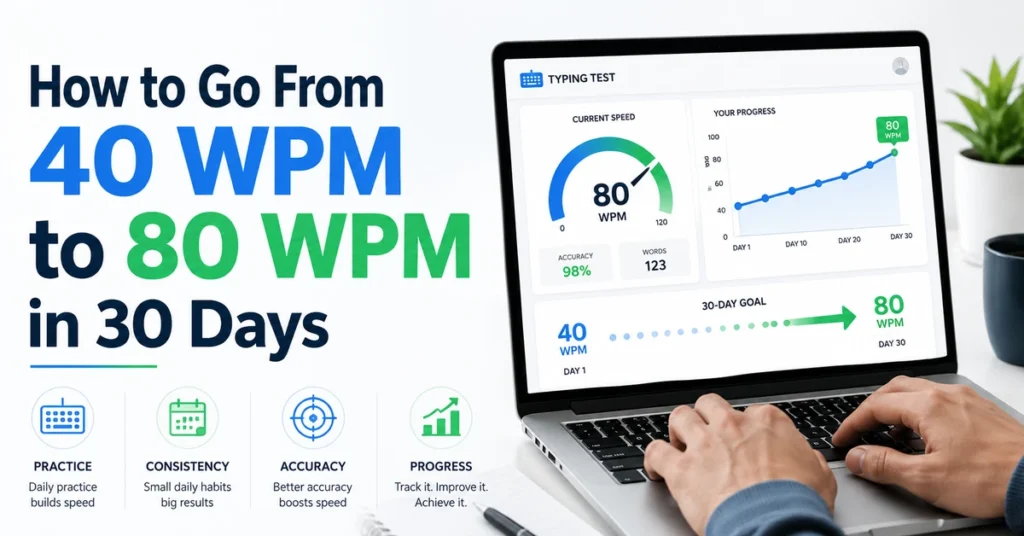
| Week | WPM | Accuracy |
|---|---|---|
| Week 1 | 42 | 92% |
| Week 2 | 41 | 97% |
| Week 3 | 45 | 97% |
| Week 4 | 49 | 98% |
Week 2 may appear to be a setback when you look only at WPM.
In reality, the learner developed a cleaner movement pattern that supported later progress.
Add Typing Endurance Practice Twice a Week
Short tests measure burst performance. Longer tests reveal whether you can maintain control.
Include typing endurance practice twice each week:
- Type for one minute.
- Rest for 30 seconds.
- Type for two minutes.
- Rest for one minute.
- Type for five minutes.
Compare the results.
Suppose your one-minute speed is 58 WPM and your five-minute speed is 43 WPM.
You probably do not need more burst practice. You need better pacing, relaxation, and longer controlled sessions.
Good typing endurance is useful for:
- School assignments
- Reports
- Data entry
- Transcription
- Employment tests
- Long emails
- Content writing
Start longer tests below your maximum pace. Racing through the first minute often causes accuracy and rhythm to collapse later.
Track Weekly Averages Instead of Daily Records
Typing speed naturally changes from one session to another.
Results can be affected by:
- Passage difficulty
- Test duration
- Keyboard type
- Warm-up
- Fatigue
- Distraction
- Punctuation
- Familiarity with the text
- Whether errors are corrected
Use a tracking table:
| Date | Test duration | WPM | Accuracy | Errors | Main focus |
|---|---|---|---|---|---|
| Monday | 1 minute | 44 | 94% | 10 | Baseline |
| Wednesday | 1 minute | 43 | 98% | 3 | Accuracy |
| Friday | 1 minute | 47 | 97% | 4 | Speed |
| Saturday | 5 minutes | 44 | 97% | 15 | Endurance |
Calculate your weekly average instead of judging yourself from one result.
The eTypingTest tool stores recent test history and displays WPM, accuracy, consistency, keystrokes per second, and test mode. This can help you compare results taken under similar conditions.
Common Typing Practice Routine Mistakes
Taking too many tests
Typing tests measure your current technique. They do not automatically correct it.
Practicing only easy words
Real typing includes capitals, punctuation, numbers, and unfamiliar vocabulary.
Chasing WPM before accuracy
Rushing reinforces incorrect movements and increases correction time.
Changing the routine every day
Give each exercise several sessions before deciding that it does not work.
Ignoring weak keys
Your complete typing speed may be limited by a few repeated hesitations.
Practicing for too long
Fatigue can reduce accuracy and produce tense, heavy keystrokes.
Looking only at your best score
One personal record does not represent your normal typing ability.
Using an uncomfortable posture
An awkward workstation can make longer practice uncomfortable and reduce control.
Typing Posture During Daily Practice
OSHA recommends arranging your workstation so your shoulders remain relaxed, your elbows stay near your body, and your wrists remain straight instead of bending upward, downward, or sideways. Keyboard height and angle should help maintain a neutral wrist position.
Before beginning your daily typing exercises:
- Place the keyboard directly in front of you.
- Keep your shoulders relaxed.
- Keep your elbows close to your body.
- Align your wrists with your forearms.
- Avoid reaching forward.
- Support your feet.
- Press the keys lightly.
- Keep the mouse close to the keyboard.
When using a palm rest, OSHA advises keeping your hands free to move while typing. The support should mainly contact the heel of the palm during pauses rather than pressing directly against the wrist.
Stop practicing if you experience persistent pain, numbness, tingling, or weakness.
How Long Should You Follow This Routine?
Follow the same basic routine for at least two weeks before making major changes.
That does not mean every exercise must remain identical. Your weak keys and practice text should change as your performance develops.
Review your routine weekly:
- Is your accuracy improving?
- Are keyboard glances decreasing?
- Is your one-minute average increasing?
- Is your five-minute speed becoming more stable?
- Are the same keys still causing errors?
- Does your posture remain comfortable?
Increase the difficulty when your current material becomes easy.
Reduce the pace when accuracy begins falling.
A good typing practice routine evolves with your skill instead of remaining fixed forever.
Frequently Asked Questions
What is the best daily typing practice routine?
A useful routine includes a warm-up, accuracy work, weak-key practice, natural text, a short speed drill, one measured test, and a quick review. Fifteen to 20 minutes is enough for many learners.
How many minutes should I practice typing daily?
Start with 10–20 focused minutes. A short, regular session is normally easier to sustain than an occasional long practice session.
Can a typing practice routine increase WPM?
Yes. A targeted routine can help reduce errors, improve finger consistency, strengthen weak keys, and gradually increase typing speed. Progress depends on your starting technique and the quality of your practice.
How can I improve WPM faster?
Identify your main limitation instead of repeatedly taking tests. Use weak-key drills, accuracy practice, controlled speed work, and longer sessions when endurance is the problem.
Should I practice typing every day?
You can practice on most days, but rest or complete a lighter session when your hands feel tired. Consistency matters more than forcing long sessions.
What is good typing practice for beginners?
Typing practice for beginners should start with home-row placement, easy words, short no-looking exercises, and high accuracy before maximum speed.
Should I focus on typing speed and accuracy together?
Yes, but train them in stages. Build accurate movements first, stabilize them, and then increase your pace gradually.
How often should I take a typing test?
One recorded test at the end of your daily session is enough. Compare weekly averages instead of taking many tests until you receive a preferred score.
How do typing accuracy exercises improve speed?
Typing accuracy exercises reduce incorrect movements and correction time. Cleaner typing can improve net WPM even before your raw typing speed changes.
How can I build typing endurance?
Complete one-, two-, and five-minute passages at a sustainable pace. Increase the duration gradually while monitoring your accuracy and physical tension.
Is 15 minutes of touch typing practice enough?
Fifteen focused minutes can be enough for steady improvement when the session includes targeted exercises and you practice consistently.
Why is my daily typing practice not working?
Your routine may contain too much testing, overly easy material, inconsistent finger use, or no review of repeated errors. Select one weakness and target it directly.
Final Thoughts
A good typing practice routine should leave you with more than a score.
You should know which keys slowed you down, whether your accuracy improved, when your rhythm became uneven, and what you will practice tomorrow.
Start with a short warm-up. Spend time on accuracy and weak keys. Practice realistic text. Add controlled speed only after your movements feel stable. Finish with one honest test and record the result.
That simple structure turns random typing into deliberate practice.
You may not set a new record every day. Some sessions will improve accuracy. Others will reduce keyboard glances or strengthen typing endurance.
Those changes are still helping you improve WPM over time.
Consistency is more useful than one exhausting practice marathon. Follow a focused daily plan, review your weekly averages, and adjust your routine as your weaknesses change.
External Resources and References
The routine in this guide is informed by research comparing distributed and massed motor-skill practice across separate sessions. Aalto University’s typing research identifies consistent finger-to-key mappings, preparation for upcoming keystrokes, and limited whole-hand movement as predictors of stronger typing performance. The posture recommendations come from OSHA’s official computer-workstation guidance. These sources support the general training principles, but individual WPM progress will vary depending on starting speed, accuracy, technique, keyboard familiarity, and practice consistency.